
Analyzing Ben Stace Semantic SEO Case Studies reveals a fundamental shift in how search engines rank content today—moving away from simple keyword matching toward complex entity recognition. As a veteran SEO with 15 years in the trenches, I’ve watched the algorithm evolve from the crude days of keyword stuffing to the sophisticated, nuance-driven AI environment we navigate now.
If you’re struggling to break through traffic plateaus or wondering why your competitors are dominating the SERPs despite having fewer backlinks, the answer likely lies in semantic relevance and topical authority.
In this comprehensive guide, we’ll dissect the methodologies found in these case studies, exploring how a structured, entity-first approach can transform your organic performance.
The digital landscape is no longer governed by who has the most aggressive anchor text profiles. Instead, Google’s BERT and MUM algorithms prioritize content that demonstrates a deep, interconnected understanding of a subject. By examining the success patterns within Ben Stace’s work, we can reverse-engineer a strategy that aligns perfectly with search intent. We’ll look at how to:
- Construct content silos
- Leverage natural language processing (NLP)
- Build a “knowledge graph” for your website that signals undeniable expertise to search engines
The Core Philosophy Behind Semantic SEO
To truly appreciate the results seen in these case studies, you must first understand the philosophy of semantic SEO strategies.
Traditional SEO was often about targeting a single keyword per page. Semantic SEO, however, is about covering an entire topic comprehensively. It involves answering every possible question a user might have and connecting those answers through a logical internal linking structure.
When we look at high-performing sites today, they don’t just have one good article—they have a cluster of content that reinforces the main entity. This is often referred to as topical authority construction. Google wants to rank sources that cover a topic exhaustively.
By using tools like Keyword Cupid or proprietary NLP software, SEOs can map out every sub-topic required to be considered an authority.
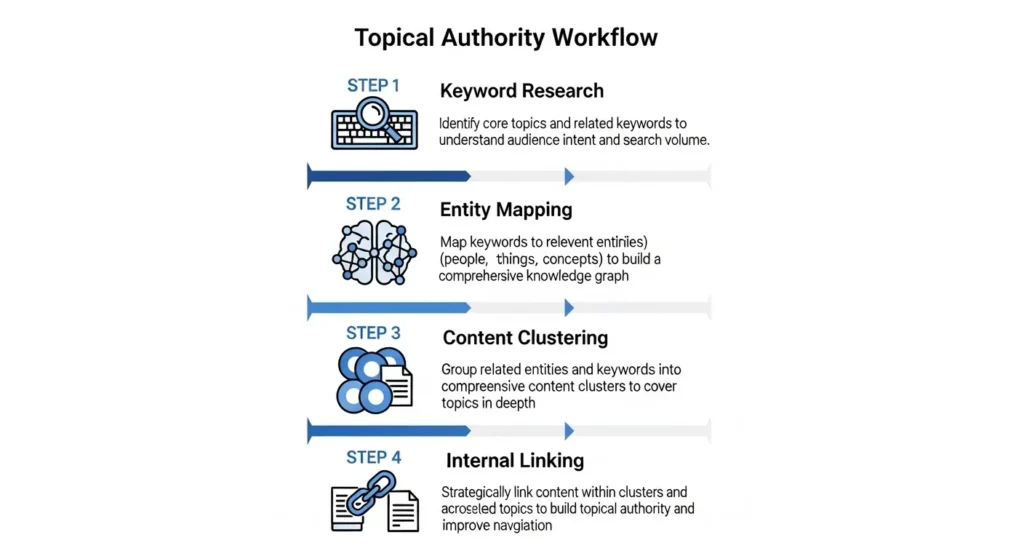
Infographic showing the structure of Ben Stace Semantic SEO Case Studies and topical mapping flow
In the context of Ben Stace Semantic SEO Case Studies, we consistently see a refusal to rely on shortcuts. The focus is always on data-driven architecture. This means analyzing the vector space modeling of top-ranking competitors and identifying the “content gaps”—not just in keywords, but in semantic entities.
If the top result talks about “costs,” “benefits,” and “historical context,” and your page only covers “costs,” you are semantically less relevant.
Case Study 1: The Affiliate Authority Site
The Challenge
One of the most compelling examples involves a stagnant affiliate site in the home improvement niche. Despite having high DR (Domain Rating) backlinks, the traffic had flatlined. The content was thin, targeting high-volume keywords without supporting articles. The site lacked entity-based optimization—it was a collection of isolated posts rather than a cohesive library of information.
The Semantic Solution
The strategy implemented was a rigorous overhaul of the site’s architecture. Using topic modeling techniques, the team identified that the site was missing crucial supporting entities. For a main topic like “kitchen renovation,” the site was missing deep dives into:
- “Cabinet materials”
- “Ergonomic layouts”
- “Plumbing regulations”
Topical Mapping: A complete map was created, outlining 50+ new articles needed to complete the “kitchen” silo.
Content Clusters: These articles were written not just for keywords, but to satisfy specific user intents found in the “People Also Ask” sections.
Internal Linking: A strict linking hierarchy was enforced. Parent pages linked to children, and children linked back to parents and laterally to siblings.
The Results
Within six months, the site didn’t just recover—it doubled its organic traffic. More importantly, the revenue per visitor increased because the traffic was more qualified. Users were landing on highly specific informational articles and clicking through to commercial pages.

Graph displaying organic traffic growth from Ben Stace Semantic SEO Case Studies implementation
This case study proves that semantic search concepts are not theoretical—they are the primary driver of modern growth. By aligning with how Google understands language, the site became the “Wikipedia” of its niche.
Case Study 2: The SaaS Platform Turnaround
The Problem: Technical Debt and Content Cannibalization
A B2B SaaS company approached with a common issue: they had hundreds of blog posts, but they were cannibalizing each other. Multiple pages were ranking for the same keywords on page 2 or 3, preventing any single page from hitting the top spots. They had no clear content silo architecture.
The Implementation of Structured Data
The intervention here focused heavily on schema markup and content consolidation. The strategy involved:
- Pruning weak content
- 301 redirecting it to stronger, more comprehensive “pillar pages”
- Implementing advanced structured data to help Google understand the relationship between the software’s features and the problems they solved
The team utilized TF-IDF analysis (Term Frequency-Inverse Document Frequency) to optimize existing content. This ensured that the vocabulary used on the page matched the expectations of the algorithm for that specific topic.
If you are writing about “CRM software,” and you don’t mention “lead management” or “automation” frequently enough relative to the corpus of the web, you are deemed less relevant.
The Outcome
The consolidation reduced the total page count by 30% but increased organic impressions by 150%. This efficiency is a hallmark of the Ben Stace Semantic SEO Case Studies methodology: less bloat, more meaning. The site established undeniable topical authority for its core software features, pushing competitors down the SERP.
Key Pillars of Semantic Strategy
Based on these case studies, we can distill the success down to a few non-negotiable pillars. Ignoring these is why most SEO campaigns fail in the long run.
1. The Knowledge Graph Integration
You must think of your site as a database of entities. An entity is a distinct, independent thing (person, place, concept). Google’s Knowledge Graph maps these entities. Your content must clearly define entities and their relationships.
Using structured data implementation (Schema.org) effectively “feeds” this graph, making it easier for Google to parse your content.
2. User Intent Profiling
Keywords act as proxies for intent, but they aren’t the intent itself. Semantic SEO requires you to analyze the search intent behind the query. Is the user looking to buy, learn, or navigate? The content structure must match this.
If a user wants a quick answer, a 3,000-word essay is semantically a poor match—even if it contains the keywords.
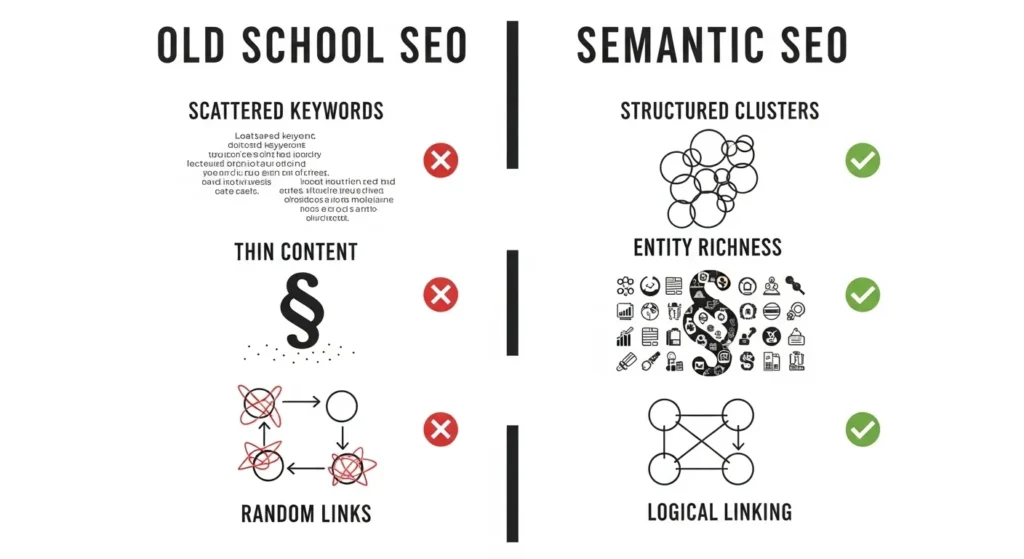
Comparison infographic of old school SEO versus Ben Stace Semantic SEO Case Studies strategies
As shown in the infographic above, the shift from “strings” (keywords) to “things” (entities) is the defining characteristic of modern search.
3. The Internal Linking Web
Links are the nerves of your website. In a semantic structure, links should not be random—they should connect conceptually related pages. This passes semantic relevance signals from your high-authority pages to your newer, deeper content.
Contextual anchor text is vital here; generic “click here” links provide zero semantic value.
Actionable Guide: Implementing Your Own Semantic Strategy
Ready to replicate the success of these Ben Stace Semantic SEO Case Studies? Follow this step-by-step framework to build your own topical map.
Step 1: The Topic Audit
Start by identifying your core “seed” topic. Use tools like Ahrefs or Semrush to find broad keywords. Then, look for LSI keywords for semantic richness and related questions. Don’t just look for volume—look for relevance.
Step 2: Construct the Map
Create a spreadsheet:
- Column A: Your Pillar Page (Main Topic)
- Columns B, C, D: Supporting cluster pages
Ensure you’ve covered the “What,” “Why,” “How,” and “Who” of your topic. You might need 20 to 50 articles to fully cover a broad topic like “Digital Marketing.”
Step 3: Draft with NLP in Mind
When writing, use tools like SurferSEO or MarketMuse. These analyze top-ranking pages and suggest contextual keyword optimization terms you might have missed—ensuring your content is semantically dense.
Step 4: Interlink Strategically
Once published, go back and link content together:
- Pillar pages → all cluster pages
- Cluster pages → pillar + related siblings
This creates a tight internal linking structure that traps authority within the silo.
Step 5: Implement Schema
Use:
- FAQ schema
- Article schema
- BreadcrumbList schema
This helps Google explicitly understand the hierarchy and context of your pages.
My Expert Opinion
I’ve spent the last decade and a half analyzing SERPs, and if there’s one thing I’ve learned from diving deep into Ben Stace Semantic SEO Case Studies and similar advanced frameworks, it’s this: Most SEOs are too impatient to succeed at this.
My “hot take”: The industry is obsessed with “quick wins” and “backlink velocity.” While backlinks still matter, they’re becoming secondary to the content graph itself.
I’ve seen sites with 50 backlinks outrank sites with 5,000 backlinks simply because the smaller site covered the topic with such semantic completeness that Google had no choice but to rank it as the authority.
The algorithm is getting smarter at ignoring “rented” authority (links) and prioritizing “owned” authority (content depth).
My advice? Stop chasing algorithm updates. Google’s goal is to organize the world’s information. If you organize your information better than anyone else—using clear entities, logical structures, and comprehensive data—you effectively “future-proof” your site.
The Ben Stace topical map expert approach isn’t a hack—it’s aligning with the fundamental mission of the search engine. That’s why it works.
FAQ Section
Q: How long does it take to see results from Semantic SEO?
A: Typically, semantic strategies take longer to mature than aggressive link building—often 3 to 6 months. However, the traffic achieved is usually more stable and resistant to algorithm updates.
Q: Do I need expensive tools to create a topical map?
A: While tools like Keyword Cupid or generic keyword clustering tools speed up the process, you can do it manually using Google’s “People Also Ask” and Wikipedia’s table of contents for inspiration.
Q: Can I apply this to a small local business website?
A: Absolutely. Local SEO benefits hugely from entity optimization. Clearly defining the service area, the services as entities, and their relationship to the location can dominate local maps.
Q: Is keyword density still a thing?
A: Not in the traditional sense. Focus on TF-IDF analysis and entity frequency rather than stuffing the exact match keyword repeatedly. Google understands synonyms and context now.

Visual representation of NLP and vector space modeling in Ben Stace Semantic SEO Case Studies
Above, we see how Natural Language Processing interprets relationships between words—which is the engine under the hood of these strategies.
Conclusion
The lessons drawn from Ben Stace Semantic SEO Case Studies provide a blueprint for the future of search. It’s a move away from gaming the system and toward building genuine, structured value.
By adopting a semantic content strategy, prioritizing topical authority, and ignoring the noise of “shiny object” tactics, you can build a digital asset that dominates the SERPs for years to come.
Start mapping your topics today—and stop writing content in the dark.