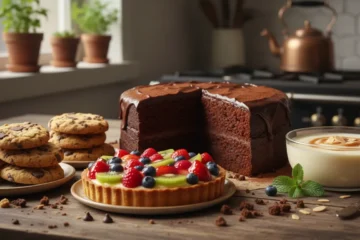
Vegan peanut butter cookies are one of the easiest vegan baking projects to nail on the first try — partly because peanut butter is already a naturally vegan ingredient, and partly because the fat and protein in peanut butter do so much structural work in the dough that eggs are easier to replace here than in almost any other cookie. Below are five complete recipes, each with its own ingredients table, covering a classic three-ingredient version, a chewy oat-based take, a chocolate chip variation, a double peanut butter stuffed option, and one gluten-free version that holds its shape just as well as any of the others.
Why Vegan Peanut Butter Cookies Work So Well
Standard peanut butter cookies use eggs for two reasons: binding and moisture. In a vegan version, flax eggs, chia eggs, applesauce, or aquafaba (the liquid from a can of chickpeas) handle the binding role, while the natural oil in peanut butter contributes enough moisture that the dough rarely needs much additional fat. The result is a cookie that’s nearly as reliable as the original — and in some versions, noticeably chewier and more peanut-forward because the egg’s protein isn’t competing with the nut butter for texture. Understanding the functional roles eggs play in cookie dough and what replaces them makes troubleshooting any vegan cookie recipe much more straightforward.
The three-ingredient version — peanut butter, sugar, and a flax egg — works because it strips the recipe down to exactly what’s needed for structure and sweetness, with nothing extra. Each subsequent recipe adds complexity, but all five follow the same core logic.
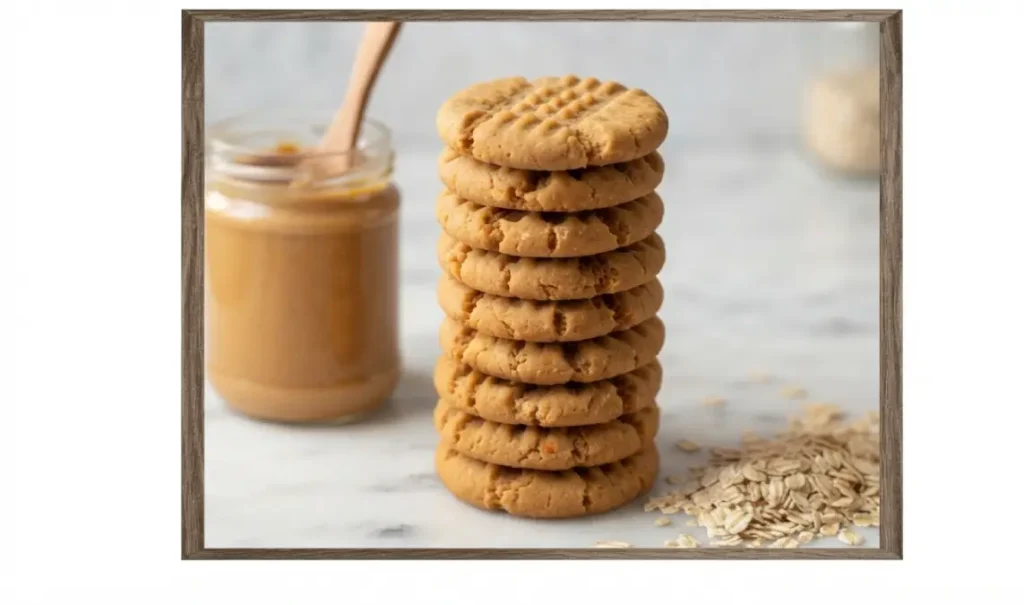
Choosing the Right Peanut Butter
The type of peanut butter you use matters more in vegan cookies than in non-vegan versions, since the nut butter does more structural work:
- Natural peanut butter (no added oil): Produces a denser, more intensely peanut-flavored cookie but can make the dough oilier and harder to roll; stir thoroughly before measuring.
- Commercial peanut butter (like Jif or Skippy): More consistent in texture and fat distribution, easier to work with, and produces a slightly more uniform crumb.
- Crunchy vs. smooth: Smooth is recommended for most of these recipes for even texture; crunchy works well in the oat-based and stuffed versions where extra texture is welcome.
For more vegan baking ideas, browse our vegan dessert ideas guide, or this primer on common egg substitutes and how each affects texture in baking.
Classic Vegan Peanut Butter Cookie Recipes
These two start from the simplest possible foundation before adding complexity.
3-Ingredient Vegan Peanut Butter Cookies
| Ingredient | Amount |
|---|---|
| Natural peanut butter | 1 cup |
| Granulated sugar or coconut sugar | 1/2 cup |
| Flax egg (1 tbsp ground flax + 3 tbsp water) | 1 batch |
- Mix ground flax with water and let sit for 5 minutes until it thickens to an egg-like consistency.
- Stir peanut butter, sugar, and flax egg together until a firm dough forms — it will be stiffer than most cookie doughs.
- Roll into balls, place on a lined baking sheet, press with a fork to create the classic crosshatch pattern, and bake at 350°F for 10–12 minutes; cool on the sheet for 5 minutes before moving since these are fragile when warm.
Chewy Oat-Based Vegan Peanut Butter Cookies
| Ingredient | Amount |
|---|---|
| Natural peanut butter | 3/4 cup |
| Old-fashioned oats | 1 cup |
| Maple syrup | 1/4 cup |
| Flax egg (1 tbsp ground flax + 3 tbsp water) | 1 batch |
| Vanilla extract | 1 tsp |
| Baking soda | 1/4 tsp |
| Salt | 1/4 tsp |
- Prepare the flax egg and let it sit for 5 minutes, then combine with peanut butter, maple syrup, and vanilla until smooth.
- Fold in oats, baking soda, and salt until evenly combined — the oats absorb some of the liquid and the dough firms up as it rests for a minute.
- Scoop onto a lined baking sheet, flatten slightly with your palm, and bake at 350°F for 11–13 minutes until just set at the edges; they firm up significantly as they cool.
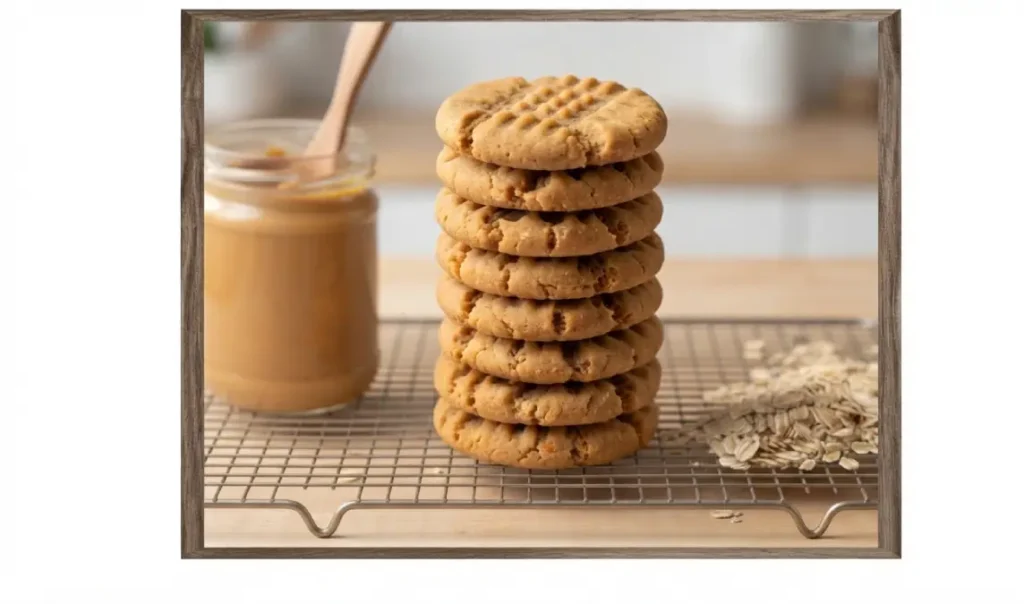
Flavored and Stuffed Vegan Peanut Butter Cookie Recipes
These two take the same base in a more indulgent direction. For more plant-based baking ideas, see our healthy dessert recipes collection.
Vegan Peanut Butter Chocolate Chip Cookies
| Ingredient | Amount |
|---|---|
| Natural peanut butter | 3/4 cup |
| All-purpose flour | 1 1/4 cups |
| Coconut sugar or brown sugar | 1/2 cup |
| Coconut oil, melted | 3 tbsp |
| Flax egg (1 tbsp ground flax + 3 tbsp water) | 1 batch |
| Vanilla extract | 1 tsp |
| Baking soda | 1/2 tsp |
| Salt | 1/4 tsp |
| Dairy-free chocolate chips | 1/2 cup |
- Prepare flax egg and let sit 5 minutes; beat with peanut butter, melted coconut oil, sugar, and vanilla until smooth.
- Fold in flour, baking soda, and salt until a soft dough forms, then gently stir in chocolate chips.
- Scoop onto a lined baking sheet, flatten slightly, and bake at 350°F for 11–13 minutes until just golden at the edges; cool for 5 minutes on the pan before transferring.
Double Peanut Butter Stuffed Vegan Cookies
| Ingredient | Amount |
|---|---|
| Natural peanut butter (for dough) | 3/4 cup |
| All-purpose flour | 1 1/4 cups |
| Coconut sugar | 1/2 cup |
| Coconut oil, melted | 3 tbsp |
| Flax egg (1 tbsp ground flax + 3 tbsp water) | 1 batch |
| Vanilla extract | 1 tsp |
| Baking soda | 1/2 tsp |
| Salt | 1/4 tsp |
| Peanut butter (for filling) | 1/3 cup |
| Powdered sugar (for filling) | 3 tbsp |
- Mix filling peanut butter and powdered sugar until smooth, then freeze in small teaspoon-sized rounds on a lined plate for 20 minutes until firm.
- Prepare the cookie dough as in the chocolate chip recipe above, omitting the chips.
- Flatten a ball of dough in your palm, place a frozen peanut butter filling round in the center, wrap the dough around it, and seal; bake at 350°F for 12–14 minutes until just set.
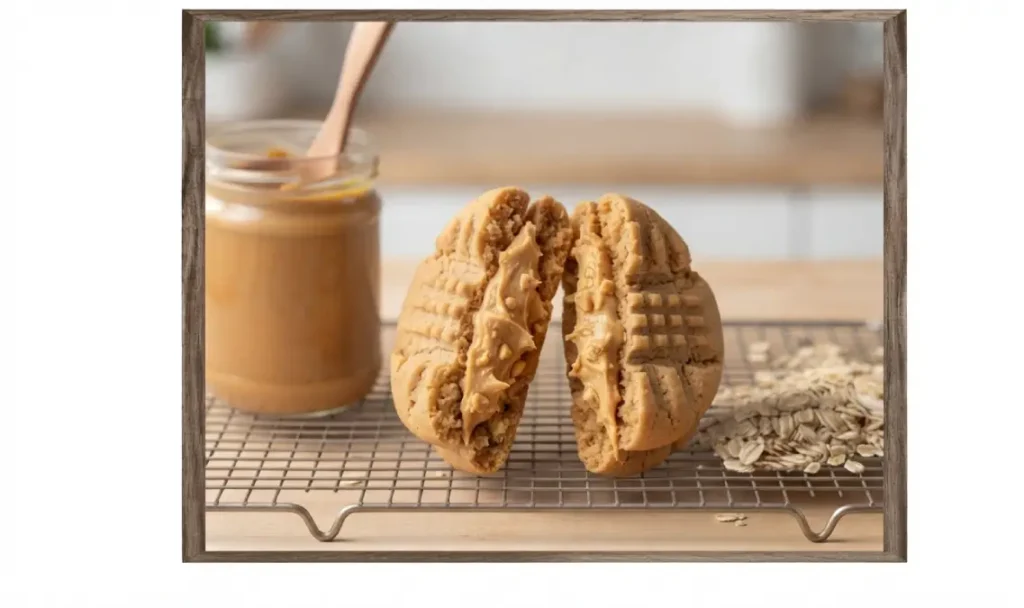
A Gluten-Free Vegan Peanut Butter Cookie
Gluten-Free Vegan Peanut Butter Cookies
| Ingredient | Amount |
|---|---|
| Natural peanut butter | 1 cup |
| Almond flour | 1/2 cup |
| Coconut sugar | 1/3 cup |
| Flax egg (1 tbsp ground flax + 3 tbsp water) | 1 batch |
| Vanilla extract | 1 tsp |
| Baking soda | 1/4 tsp |
| Salt | 1/4 tsp |
- Prepare flax egg and let sit for 5 minutes, then mix with peanut butter, coconut sugar, and vanilla until well combined.
- Fold in almond flour, baking soda, and salt until a firm dough forms — almond flour makes this dough slightly stickier than wheat flour versions, so chilling for 15 minutes before rolling helps.
- Roll into balls, press with a fork, and bake at 325°F for 11–13 minutes; cool fully on the sheet since gluten-free cookies are particularly fragile when warm.
Tips for Perfect Vegan Peanut Butter Cookies Every Time
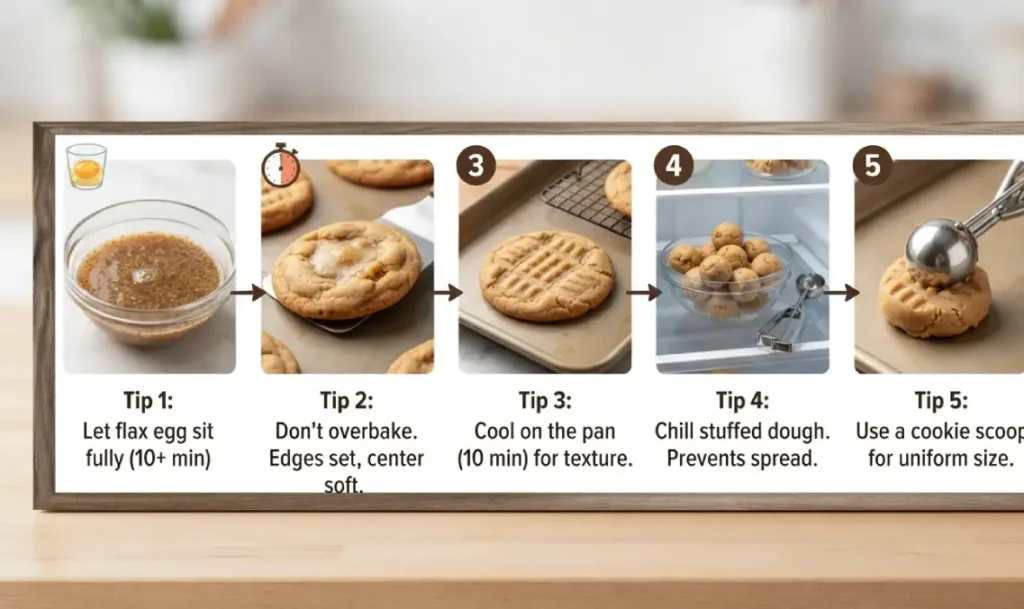
- Let the flax egg sit long enough. A full 5 minutes — not 2 or 3 — is what allows the flax to fully absorb the water and develop the gel-like consistency that mimics an egg’s binding properties.
- Don’t overbake. Vegan cookies continue cooking on the hot pan after the oven is off; pulling them out when they look just barely set at the edges rather than fully done is almost always the right call.
- Cool on the pan, not a rack. Especially for the three-ingredient and gluten-free versions, which are more fragile — letting them firm up on the hot baking sheet for at least 5 minutes before moving prevents crumbling.
- Chill stuffed cookie dough if it gets sticky. Room temperature peanut butter dough softens quickly, especially in a warm kitchen; 10–15 minutes in the fridge between batches keeps it manageable.
- Use a cookie scoop for consistent sizing. Even sizing means even baking — no underdone centers while the edges overbake in the same tray.
Frequently Asked Questions
Q: Can I use a chia egg instead of a flax egg?
Yes — 1 tablespoon of chia seeds mixed with 3 tablespoons of water works as a direct substitute; the gel forms slightly faster than flax and produces a nearly identical binding effect.
Q: Can I use almond butter or sunflower seed butter instead of peanut butter?
Yes — both work as direct substitutes in equal amounts; sunflower seed butter is a good nut-free option, though it can turn baked goods slightly green due to a reaction between its chlorogenic acid and baking soda.
Q: Why are my vegan peanut butter cookies crumbling?
This is almost always from moving them too soon after baking — vegan cookies without egg protein are more fragile when warm and need more cooling time than conventional cookies before they hold together cleanly.
Q: Can I freeze vegan peanut butter cookie dough?
Yes — scoop into balls, freeze on a lined tray, then transfer to a freezer bag; bake from frozen adding 2–3 minutes to the baking time.
Q: Do these cookies taste noticeably different from non-vegan versions?
The three-ingredient and oat versions are the most different — slightly denser and more intensely peanut-flavored. The chocolate chip and stuffed versions are close enough that most people can’t distinguish them in a blind taste test.
Q: How long do vegan peanut butter cookies stay fresh?
At room temperature in an airtight container for 4–5 days; in the fridge for up to a week; or frozen for up to 2 months.
My Expert Opinion
After developing vegan baking recipes professionally for years, my honest take is that vegan peanut butter cookies are one of the best entry points for anyone new to vegan baking — not as a compromise or a challenge but because they genuinely rival their conventional counterparts when made well. The three-ingredient version in particular is the one I demonstrate most often to skeptics, specifically because the short ingredient list makes it impossible to attribute the good result to anything other than the technique. My personal favorite of the five is the stuffed version — the frozen peanut butter filling creates a soft, almost creamy center that contrasts with the slightly crisped exterior in a way that most standard cookies, vegan or otherwise, can’t match. The key detail most people skip is freezing the filling long enough; a partially frozen center melts too quickly in the oven and disappears into the dough rather than staying distinct.
Conclusion
Vegan peanut butter cookies prove that removing eggs from a recipe doesn’t mean removing quality — it means understanding what eggs were actually doing and choosing the right substitute. Whether you start with the three-ingredient version for simplicity, the oat-based version for chewiness, or the stuffed variation for something more indulgent, each ingredients table above gives you a reliable, repeatable result that stands on its own merits regardless of whether anyone at the table is vegan.