
DeepIP AI patent tools are fundamentally reshaping the landscape of intellectual property management, offering unprecedented efficiency and accuracy for patent attorneys and inventors alike. In an era where the volume of global filings is exploding, relying solely on manual keyword searches and traditional drafting methods is no longer a sustainable competitive advantage.
Whether you are a solo practitioner looking to scale your output or an in-house counsel managing a massive portfolio, understanding the capabilities of these advanced AI-powered systems is crucial. The integration of generative AI for patent drafting and semantic analysis has moved beyond novelty—it is now a critical component of modern legal tech stacks.
The promise of these tools goes beyond simple automation. We are talking about a paradigm shift in how we conceive, protect, and monetize innovation. By leveraging Large Language Models (LLMs) specifically trained on patent data, DeepIP AI patent tools allow for a level of nuance and context-awareness that Boolean strings simply cannot match.
In this comprehensive guide, we will explore:
- The mechanics of these platforms
- How they compare to legacy systems
- A practical roadmap for integrating them into your workflow to maximize ROI
The Evolution of Patent Tech: From Boolean to Generative AI
To truly appreciate the power of modern tools, we must first look at where we came from.
For decades, patent professionals relied on rigid, syntax-heavy search queries. If you missed a specific synonym or classification code, you missed the prior art. This era was defined by the skill of the searcher in manipulating database logic—a time-consuming process fraught with the risk of human error.

The introduction of semantic patent search software marked the first major leap. Suddenly, algorithms could understand the “meaning” behind a paragraph, not just the specific words used.
However, the real revolution arrived with the advent of generative AI. Today’s tools do not just “search”—they “understand” and “create.” They can:
- Draft comprehensive patent specifications
- Suggest claims based on invention disclosures
- Predict the likelihood of rejection based on examiner history
This is the domain where DeepIP and similar platforms excel—bridging the gap between raw data and actionable legal strategy.
Why Traditional Methods Are Failing
The traditional approach to patent prosecution is becoming increasingly untenable due to several converging factors:
- Exponential growth in prior art: Millions of new documents are published annually. The “needle in a haystack” metaphor is outdated—it’s now a stack of needles.
- Rising technical complexity: Fields like AI, biotech, and quantum computing demand deep domain knowledge that manual classification struggles to capture.
- Changing client expectations: Innovators demand faster turnaround, lower costs, and high-quality output.
A recent WIPO report highlighted the growing pressure on patent offices and firms to process applications more efficiently. Tools that fail to leverage natural language processing in IP are simply too slow to keep up with the pace of modern innovation.
Automated patent analysis is no longer a luxury—it’s a necessity for survival.
Core Capabilities of DeepIP AI Patent Tools
When we discuss DeepIP AI patent tools, we refer to a modular suite that covers the entire patent lifecycle—not a monolithic system, but an agile platform targeting specific pain points in prosecution.
1. AI-Powered Prior Art Search
The cornerstone of any robust IP strategy is the validity search. AI-powered engines use vector-based indexing to find conceptually similar documents—even if they use different terminology.
Example: A search for a “fastening mechanism” may retrieve references to “adhesives,” “rivets,” or “interlocking clasps” based on contextual understanding—dramatically reducing the risk of missing critical prior art.
2. Automated Patent Drafting
This is perhaps the most transformative capability. Tools like DeepIP can:
- Ingest a rough invention disclosure or technical notes
- Output a structured patent application (background, detailed description, abstract)
- Generate a preliminary set of claims
While human review is essential, this eliminates the dreaded “blank page problem,” freeing attorneys to focus on high-value strategic analysis instead of boilerplate formatting.
3. Office Action Response Assistance
Receiving a USPTO rejection is routine—but responding is time-intensive. Advanced AI can:
- Analyze the examiner’s arguments
- Cross-reference cited prior art with applicant claims
- Suggest persuasive counter-arguments
This streamlines prosecution and accelerates the path to allowance.
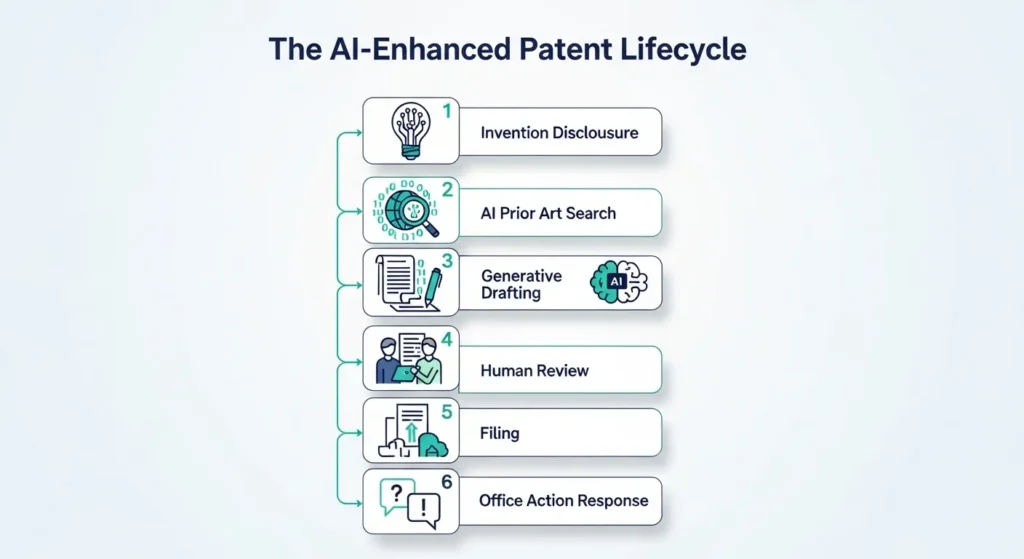
The infographic above illustrates how data flows seamlessly from prior art search → drafting → claim refinement, ensuring terminological and conceptual consistency throughout the application.
Comparative Analysis: DeepIP vs. The Market
The patent analytics market is crowded. Understanding where DeepIP stands relative to competitors is key to making a smart investment.
| Platform | Strengths | Weaknesses |
|---|---|---|
| Patsnap | Massive datasets; strong in chemical/bio search | Complex UI; expensive for small firms |
| IPRally | Graph-based search mimics examiner logic | Limited drafting capabilities |
| DeepIP | Best-in-class generative drafting; integrates with Microsoft Word | Less specialized in niche verticals (e.g., pharma chemistry) |
DeepIP’s differentiator: Its “copilot” approach—embedding directly into familiar tools like Word—makes adoption smoother than browser-based dashboards.
The Role of Specialized Vertical Tools
Not all AI is created equal across industries. For example:
- Pharmaceutical FTO (Freedom-to-Operate) searches demand precision in chemical structure recognition
- General-purpose LLMs may miss subtle distinctions in organic chemistry
Always verify whether DeepIP (or any platform) has been fine-tuned on domain-specific corpora relevant to your field.
The Business Case: ROI of AI Patent Technology
Adopting AI patent tools isn’t just an IT decision—it’s a strategic business move. ROI manifests in three key areas:
1. Cost Reduction
- Automate 30–40% of drafting and landscape analysis
- File more patents with the same in-house budget
2. Quality Improvement
- AI consistently checks for antecedent basis, indefiniteness (112 issues), and formatting errors
- Reduces formal rejections and costly prosecution rounds
3. Strategic Agility
- AI identifies technology white spaces where competitors haven’t filed
- Enables proactive R&D and defensive “fencing” strategies
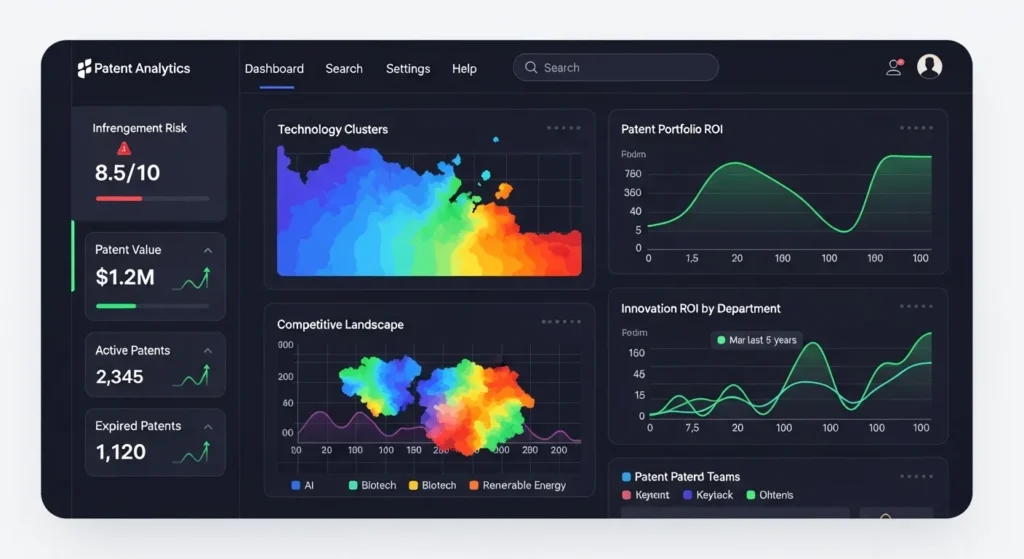
The dashboard above visualizes infringement risks and portfolio valuation, giving C-suite leaders actionable IP intelligence for strategic decisions.
Step-by-Step Guide: Integrating DeepIP AI Tools into Your Workflow
Adoption doesn’t have to be disruptive. Follow this phased approach:
Step 1: Run a Pilot Program
- Select a small “tiger team” of tech-savvy attorneys
- Test the tool on closed cases with known outcomes
- Benchmark AI performance against human results
Step 2: Prioritize Data Security
- Confirm the vendor offers zero-data-retention or private cloud options
- Ensure SOC 2 Type II compliance
- Never input confidential data into public AI interfaces (e.g., ChatGPT)
Step 3: Adopt a “Hybrid” Drafting Workflow
- Draft claims manually (this remains the gold standard)
- Feed claims into AI to auto-generate description, background, and abstract
- Focus human effort on scope strategy, not repetitive writing
Step 4: Provide Continuous Feedback
- Flag irrelevant search results
- Train the AI on your firm’s technical domains and stylistic preferences
Step 5: Shift to Strategic IP Management
- Run quarterly FTO reports on key products
- Monitor competitor filings via landscape analytics
- Evolve from “patent filer” to IP strategist
FAQ: Common Questions About DeepIP AI Tools
Q: Will using AI tools compromise my client’s confidentiality?
A: Enterprise-grade tools like DeepIP are built for legal compliance. But always verify:
- Data silos are enforced
- Your inputs aren’t used to train public models
- The vendor is SOC 2 Type II certified
⚠️ Never use free, public LLMs for confidential IP work.
Q: Can AI really replace a patent attorney?
A: No. AI is a force multiplier, not a replacement. It cannot:
- Conduct client interviews
- Interpret business strategy
- Argue before the PTAB or courts
It automates routine tasks, not legal judgment.
Q: How accurate are AI-powered prior art searches vs. professional firms?
A: AI is fast and increasingly accurate, but may miss:
- Non-patent literature (e.g., conference papers)
- Poorly indexed foreign documents
For high-stakes litigation, use a hybrid approach: AI + human expert.
Q: Is DeepIP better than generic LLMs like GPT-4?
A: Yes—dramatically.
- DeepIP is fine-tuned on patent law, MPEP, and court rulings
- It understands that “comprising” ≠ “including” in claim construction
- Generic models lack this domain-specific precision
My Expert Opinion
Having spent 15 years in patent prosecution—from paper files to cloud platforms—I’ve seen trends come and go. But this is different.
DeepIP AI patent tools are not a fad. They’re the biggest disruption since USPTO digitization.
But here’s my hot take:
In the short term, these tools may increase workload for conscientious attorneys. Why?
Because while AI lowers the barrier to content creation, your ethical duty remains unchanged. If AI generates a 50-page spec in 5 minutes, you still must review every line for:
- Enablement
- Best mode
- Accuracy
The danger isn’t the tech—it’s complacency.
The winners in 2025 won’t use AI to work less—they’ll use it to work deeper.
They’ll trade drafting time for strategic claim design, validity analysis, and litigation-proof portfolios.
If you’re using DeepIP just to churn out cheap patents faster, you’re missing the point.
Use it to draft better patents—ones that win in court.

As shown above, the future of IP is collaborative: human intelligence + machine speed.
That’s where true IP strategy automation creates value.
Conclusion
The intellectual property landscape is shifting beneath our feet. DeepIP AI patent tools offer a compelling path forward—blending the speed of automated prosecution with the precision of semantic AI.
From revolutionizing drafting workflows to delivering deep competitive intelligence, these platforms are essential for any modern IP practice.
The question is no longer if you should adopt AI—but how quickly you can integrate it to gain a strategic edge.
Embrace the change. But remember: the tool is only as good as the master wielding it.
Start your journey today—and position yourself at the forefront of the legal tech revolution.